
On the Commonplace Book
We should follow the examples of bees.

When I was in sixth grade, reading Dickens and Hawthorne and the Brontës like every normal kid, I’d bring sentences I didn’t understand to my dad — a geophysicist with a poet’s soul. We’d look the words up in the dictionary together, talk about how they were being used, work our way to a collective understanding of the sentence. He told me when he was younger, he kept track of new words he was learning in a small pocket notebook. As a would-be writer, I needed no encouragement to follow his example.
The notebook full of unknown words in The House of the Seven Gables was my first commonplace book1, though I had no idea such a thing had a name at the time. It was a place where I kept words and their definitions. My notebooks later became a place where I copied out passages from my reading that struck me either for their content or construction, or both.
Maybe you’ve heard of a commonplace book before. Your English teacher might have assigned one in junior high or you stumbled across the idea on Reddit on a rainy night. Or maybe you haven’t encountered it at all — which is fine, because the definitions are as many and varied as the number of subreddits devoted to the subject.
Since stumbling across my grandmother’s commonplace book this week, they’ve been on my mind. I’m here to offer you my version: what I keep, why I keep it, and how it’s formed my writing life.
“We should follow the examples of the bees, who flit about and cull the flowers that are suitable for producing honey, and then arrange and assort in their cells all that they have brought in.
Then we should so blend these several flavors into one delicious compound that, even though it betrays its origins, yet it nevertheless is clearly a different thing from whence it came.”
What I Keep in My Commonplace Book
My commonplace book isn’t a journal or a quote book. It’s my reading memory. When I study in the morning, it’s right next to me, and I keep it on my desk as I’m working to refer to, and add to, throughout the day.
If you flip through my current book, you’d find:
Passages I’ve copied out that moved me for their beauty or truth or both — a practice I’ve kept since childhood
To-do lists
Ideas generated from reading
A one-sentence (or even one-phrase) description of my morning
Things that make no sense
Honestly though, I’m not sure I can explain it without showing you an example.
Below is a page from my current commonplace book that I picked to show you because it had the word “underwear” for no apparent reason.
Let’s take a little tour of the page.
I use the Moleskine Pro Notebook. (Moleskine does not pay me to say that, but I wouldn’t mind if they did.) This notebook pleases me in several ways. It has a date at the top, along with a separate top section. I think business people might use that section to write an executive summary of a meeting or something. I use it to write a phrase about the morning.
Below that is the main section of the page which I use to copy out passages from the books I’m reading — usually a little philosophy or theory, a little scripture, a little poetry.
Usually, but not on this specific page for some reason, I give myself the task of writing a couple of sentences that connect the passages I’ve copied out. This exercise keeps me synthesizing what I’m reading in new ways, since I can’t spend my whole life in grad school. (So they say.)
On the right side of the page is my favorite column.
What is it for?
Who knows?
Anything!
Lists or tasks or notes
or weird doodles or questions
or things that make no sense!
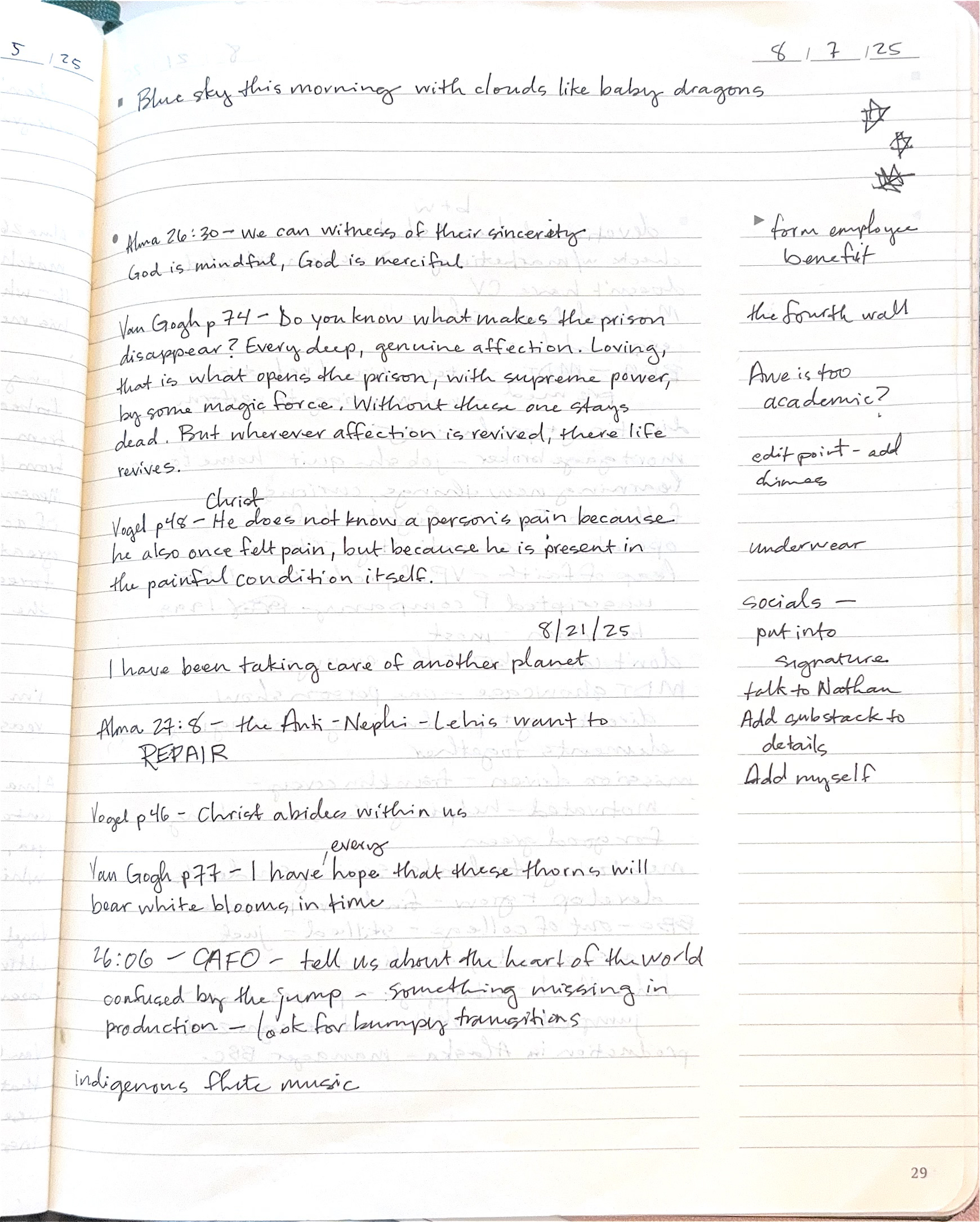
I can see why this system has worked so well for me the last ten years or so — especially after my recent ADHD diagnosis. It’s organized but not too organized — and I have a space for the random thoughts I’m always having — like “underwear” and “indigenous flute music.” These righthand column notes are not always intelligible or meaningful when I return to them, and that doesn’t bother me in the least — in fact, sometimes it leads to the most interesting connections of all.
I learned just today that a true commonplace book has headings to organize the information. It’s not something I’ve ever done, but I do often transcribe my commonplace books onto the computer and put the passages and ideas into categories at that point, so don’t come after me.
My only commonplace regret is that I cannot draw — I feel like my commonplace book would truly benefit from bug diagrams and sketches of my garden, but I am relegated to the use of words only.
Why I Keep a Commonplace Book
Writing with a pen on paper keeps something I’ve read or thought in my brain like nothing else. I often can’t pull a quote of the air, but my brain easily remembers where it is in my commonplace book. I’ve tried keeping it on the computer for ease of automated search, but without fail, my brain has no idea what’s on the computer but can recall what books I’ve read and recorded in my notebook.
I am convinced that copying out beautiful passages for my whole life has made me a better writer. When I’m working on something of my own, I don’t knowingly copy any other writer’s sentences, but they are in my head, and because they are in my head, my head comes up with better things. My brain isn’t predictive, it’s surprising!
Personal opinion, but the best writing makes connections between things that are exciting and new — that is, the “things” themselves aren’t new, but the connections are. By reading different types of texts across genres and subjects and then challenging myself to connect them, I come up with ideas that surprise me every time. And that’s the true joy of writing.
My commonplace books are not just a history of what I’ve read, but a history of how I think. Going back through my old books is so delightful, not only because I am reminded of things I’ve forgotten, but also because I can see the evolution of my own way of thinking. I can see that I’ve grown, gained more perspective, and developed more interesting ways of connecting ideas.
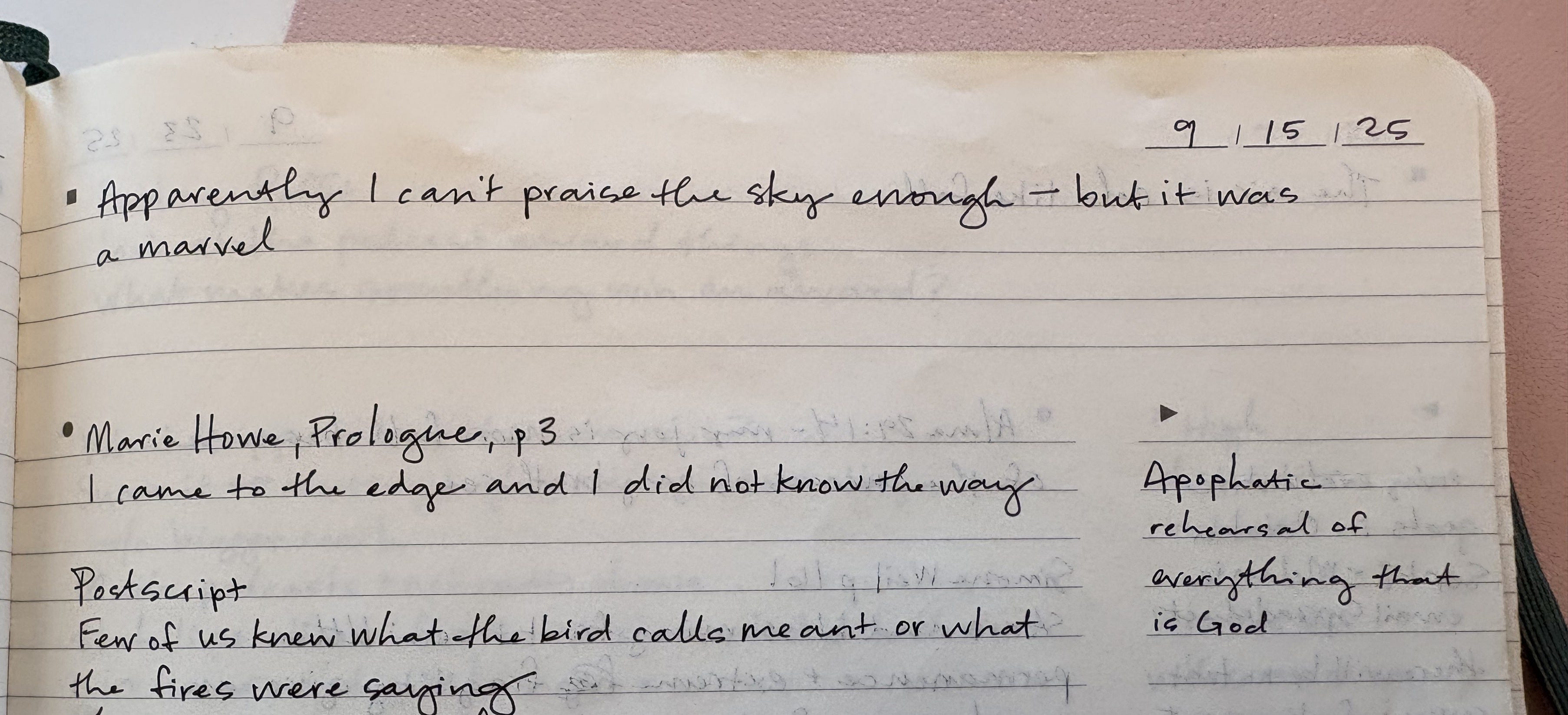
Often, I will flip back through my book and see a sentence I wrote about the morning, like this one from September 2025, “Apparently I cannot praise the sky enough — but it was a marvel,” and it becomes part of a poem or essay. In this case, that line is part of a poem that’s forthcoming in Literature and Belief. (Woo hoo!)
My Grama’s Commonplace Book
My maternal step-grandmother kept a commonplace book embellished with stickers and stamps and typed on a typewriter. It fascinated me when I visited — she was a true lifelong scholar who always kept notes on what she read.
When I was a teenager, my grandpa sent me a Xerox of the entire book and asked me to typeset it on the computer so that he could print a copy for all of the grandchildren. For some reason, I never did the typesetting and probably owe apologies to all my cousins who don’t have a copy, but I ran across that three-ring binder of copied pages last night. Reading it cover to cover wasn’t like reading a journal of daily dos and so forth, it was like being with my grandmother again and seeing her brain work.
Here’s a snippet of my grama’s thinking:


What’s Commonplace Today
This morning I wrote at the top of my page: “getting small, so you can feel big,” a line from Constant Wonder’s Hank Lentfer episode that we recently finished. I know what Hank Lentfer meant by it, but the truly great thing about my commonplace book is that I get to spend time thinking about what I mean when I write it. And it might take me weeks or months of reading to connect that idea with another idea with another idea and see the magic of the bees (see Seneca) come together to make something altogether otherworldly and beyond my individual capacity.
I initially started this substack as place to put my commonplace book notes (you can find a few of those posts here and here and here), because I would often call my sister to discuss what I was reading and thinking, and those were such tremendous and expanding conversations. It seemed like such a cool idea to put my commonplace book out there for other people’s reactions and ideas. I still like that idea and maybe wandered away from it too quickly.
Maybe we can make a commonplace book club where we all share where our brains are spending time?
I’d love to know if you already keep a commonplace book and, if you do, how you approach it — or if something about this little piece inspired you to begin.
A PhD candidate at Princeton University in musicology named John Ahern has written a lovely and useful explanation of the commonplace book, complete with instructions on starting your own.
My digital notes let me organize by hashtags, which I really need when I want to find that one poetry idea from two months ago! But the physical one seems so much more cozy.
This is what I have been calling a writers notebook. I have piles of them, less now that I'm primarily digital, but I miss the pen and paper versions. Overheard dialogue. Fragments of memories. Incredible sentences. Names to use for characters in my work. Drawings of strangers on a train. Ideas for this or that. Always carry a notebook. And a pen.